

Navigating the 2026 Plastic Tax: Why Mono-Material Eco Pouch Vacuum Bags Are Your Best Solution
Release time: 2026-02-04
Let’s be honest for a second: looking at the current packaging landscape feels a bit like navigating a minefield. Between the UK’s Plastic Packaging Tax, the expanding regulations across the EU, and the shifting compliance standards in US states like California, it’s not just about “going green” anymore. It’s about staying profitable.
If you are a brand owner or a procurement manager, you’re likely staring at a spreadsheet right now, calculating how much traditional PA/PE (nylon/polyethylene) laminates are going to cost you in taxes next year. The numbers aren’t pretty.
This is exactly why the industry conversation has shifted so aggressively toward the Eco Pouch Vacuum Bag. But I’m not talking about the vague “biodegradable” claims that got everyone in trouble a few years ago. I’m talking about the real game-changer: mono-material recyclable pouches.
Here is why making the switch isn’t just an environmental choice—it’s a survival strategy for 2026.
The Problem with Traditional Vacuum Bags
To understand why the Eco Pouch Vacuum Bag is gaining so much traction, we have to look at what we are leaving behind.
For decades, the gold standard for vacuum sealing was the multi-layer structure. Usually, this meant laminating nylon (for strength and puncture resistance) with polyethylene (for sealing). It worked great for the product, but it was a nightmare for the planet.
Why? Because you cannot easily separate nylon from PE in a recycling facility. They have different melting points. So, those billions of bags ended up in landfills or incinerators.
Under the new 2025-2026 tax laws in many regions, packaging that is “hard to recycle” is getting hit with heavy penalties. If your packaging isn’t part of the circular economy, your margins are going to take a direct hit.
Enter the Mono-Material Solution
This is where the modern Eco Pouch Vacuum Bag shines. The technology has finally caught up to the ambition.
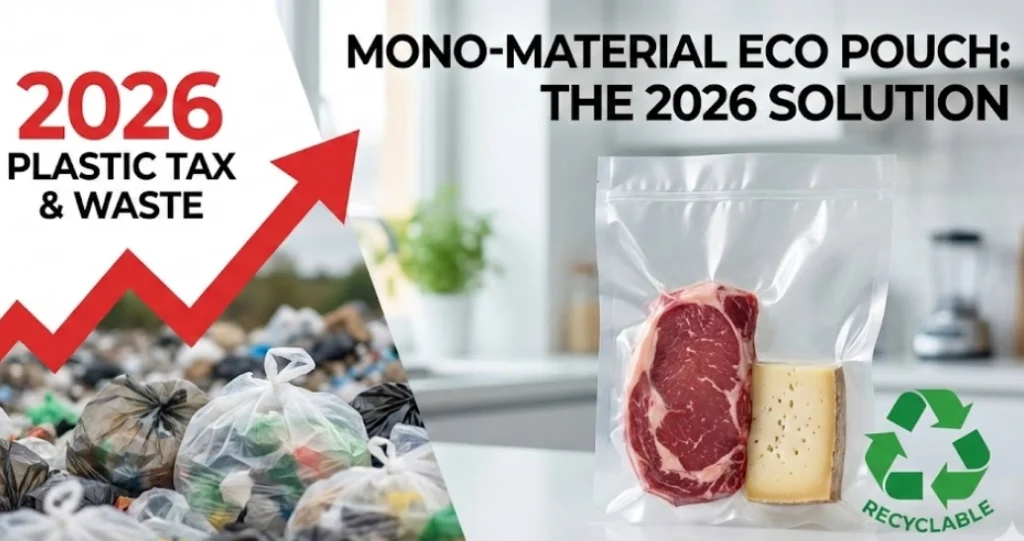
The latest generation of these bags is typically made from a full PE/PE structure (polyethylene on polyethylene). Because the entire bag is made from the same polymer family, it can be melted down and recycled into new pellets without complex separation processes.
For recyclers, this is gold. For your business, it means your packaging falls into the “Recyclable” category (Code 4), often exempting you from the steepest tier of plastic taxes.
“But will it stay fresh?” (The Barrier Myth)
I hear this objection all the time from clients. “If I switch to an Eco Pouch Vacuum Bag, will my shelf life tank? Is it just a glorified sandwich bag?”
Three years ago? Maybe. Today? Absolutely not.
The engineering behind these pouches now incorporates high-barrier EVOH (ethylene vinyl alcohol) coatings. This ultra-thin layer provides the oxygen and moisture barrier needed to keep meat, cheese, or industrial parts fresh, but it’s thin enough that it doesn’t disrupt the mono-material recycling stream.
You are getting the best of both worlds:
- Commercial-grade protection: Oxygen Transmission Rates (OTR) that rival traditional nylon bags.
- Sustainability: A verifiable, recyclable end-of-life story.
Marketing Wins: Consumers Are Savvy
Beyond the taxes and the technical specs, there is the consumer angle. Shoppers in 2026 are smart. They know the difference between “greenwashing” and actual recyclability.
When you put your product in a certified Eco Pouch Vacuum Bag with a clear “Recycle Ready” logo, you aren’t just packaging a product; you are communicating brand values.
I’ve seen brands revamp their entire image just by changing their packaging. It signals that you aren’t just reacting to laws; you are proactively caring about the waste stream. That builds trust, and trust builds retention.
Making the Switch: What to Look For
If you are ready to source an Eco Pouch Vacuum Bag for your production line, don’t just click “buy” on the first option you see. Here is a quick checklist to ensure you are getting quality:
- Transparency: Ask for the Technical Data Sheet (TDS). Confirm it is a Mono-PE structure.
- Certification: Does it have certifications like Interseroh or Cyclos-HTP? These matter for European customs.
- Puncture Resistance: If you are packaging bone-in meat or sharp industrial parts, ask for a thicker gauge (e.g., 100-150 microns). Mono-material is strong, but physics is still physics.
- Sealability: These bags seal slightly differently than nylon. Make sure your supplier offers samples so you can adjust your vacuum chamber settings (usually a slightly lower temperature is needed).
The Bottom Line
The era of “take-make-waste” is closing fast. The regulations coming into full effect in 2026 are designed to force the hand of manufacturers, but they also offer an opportunity.
Switching to a mono-material Eco Pouch Vacuum Bag helps you dodge the plastic tax, future-proof your supply chain, and give your customers what they actually want. It’s one of those rare business decisions where the ethical choice is also the most profitable one.
Don’t wait until the tax bill arrives to look for alternatives. The future of packaging is already here, and it’s fully recyclable.